CNN analysis examines uncertainties in US-Iran framework deal
Source: CNN · All CNN reports
Unlock the full scoreboard
Letter grade, factuality, lean, and rationales — free with registration. No card required.
See grades free How grading works
Already have an account? Sign in. The full report below is free to read.
Embed this grade
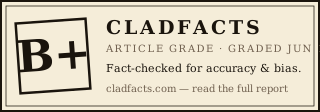
Disagree with this grade or political lean?
Flagging is open to every reader with a free account. Sign in or create one to dispute this report.
Topics in this report
Summary
The segment discusses a US-Iran framework agreement or memorandum of understanding to end recent fighting, reopen the Strait of Hormuz, and address related issues, with a signing expected Friday. Analysts highlight unresolved tactical, operational, and strategic hurdles including mines, Israel-Hezbollah tensions, and Iran's nuclear stockpile. It covers President Trump's comments on the deal, a G7 meeting, European involvement, and potential effects on Russia. Guests include retired Admiral James Stavridis and commentator Sabrina Singh. Sourcing relies on named experts, quotes from US officials like Mike Waltz, Iranian statements, and references to a New York Times interview with Trump.
Editorial Assessment
The broadcast accurately conveys the preliminary nature of the MoU and key sticking points such as the ~1,000 pounds of 60% enriched uranium and Strait clearance timelines, consistent with contemporaneous reporting. Viewers may miss that the deal remains unsigned with Iranian final approval pending and nuclear talks deferred 60 days. Framing stresses 'sand in the gears' and Israeli dissatisfaction, which matches public critiques but could benefit from more detail on mediation roles or economic impacts. Overall, it provides useful expert context on logistics without major factual errors, though anonymous diplomat references in related coverage underscore verification challenges.
Key Moments
US and Iran reached framework to end fighting with signing set for Friday
Multiple outlets including Axios and AP confirm preliminary MoU text agreed upon, with Trump and mediators announcing expected signing around June 13-14, 2026
Iran holds 1,000 pounds of highly enriched uranium with no clear removal path
IAEA data and US estimates cited in CNN/NPR reports confirm ~970 lbs of 60% enriched uranium; removal is a noted negotiation gap
Strait of Hormuz reopening will take weeks due to mines and logistics
Plausible per expert analysis; sources note Iran must clear mines and shippers determine confidence, but no public timeline specifics confirmed
Israel unhappy with deal over proxies and missiles, similar to JCPOA criticism
Reports confirm Israeli concerns and statements on continued operations in Lebanon
Notable Concerns
- Reliance on preliminary statements before formal signing
Sources Consulted
- What's in the Iran deal Trump says he's ready to sign
- US and Iran Reach Framework Deal to End War, Reopen Hormuz
- US and Iran have agreed to wording of a deal to end their war
- 'Sand in the gears": Retired admiral reacts to new agreement between US and Iran
- Trump says deal to end war will be signed on Sunday, Iran questions timing
- U.S. and Iran Move Toward Agreement to Reopen the Strait of Hormuz
- Ceasefire Deal Within Reach, U.S. and Tehran Say
- The U.S. and Iran Might Actually Have a Deal
- Pakistan's PM says 'final text' of US-Iran deal agreed
- Trump: Iran deal to reopen Strait of Hormuz 'largely negotiated'
- U.S.-Iran Ceasefire and Negotiations: Assessment and ...