Expert Panel Assesses Trump-Xi Beijing Summit Outcomes and Regional Implications
Source: East Asia Institute · All East Asia Institute reports
Unlock the full scoreboard
Letter grade, factuality, lean, and rationales — free with registration. No card required.
See grades free How grading works
Already have an account? Sign in. The full report below is free to read.
Embed this grade
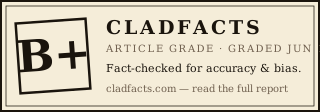
Disagree with this grade or political lean?
Flagging is open to every reader with a free account. Sign in or create one to dispute this report.
Topics in this report
Summary
The webinar featured three panelists—Robert Ross of Boston College, Yu Jun of Peking University, and Jay Chu of Kong University—discussing the recent Trump-Xi summit in Beijing. Segments covered summit outcomes including new trade and investment commissions, Boeing aircraft purchases, agricultural deals, and framing of relations as 'strategic stability' with managed competition. The second half addressed Taiwan restraint signals, Iran and Ukraine cooperation limits, North Korea nuances, and implications for South Korea's diplomacy amid perceived US retrenchment. Sourcing relied on White House fact sheets, Chinese statements, Fox and NBC interviews, and open media; no live graphics or additional guests.
Editorial Assessment
The discussion accurately captured the summit's emphasis on preliminary, quid-pro-quo steps rather than breakthroughs, consistent with official readouts on Boeing, agriculture, and dialogue mechanisms. Viewers may miss that many agreements remain aspirational or subject to implementation hurdles, with limited detail on verification. Framing highlights US power transition realities and South Korean concerns over conditional commitments, providing useful regional context but underplaying potential alliance reassurance options. Overall quality is high for an academic webinar, though optimistic tones on reciprocity assume follow-through not yet evidenced in reporting.
Key Moments
Summit established commissions on trade and investment to negotiate tariffs and deals case-by-case.
Matches White House fact sheet and media reports on new bilateral boards.
China agreed to purchase 200 Boeing aircraft in exchange for US tech/equipment support for C919.
Confirmed in White House readout and Boeing statements; reciprocal elements noted in coverage.
Trump signaled restraint on Taiwan independence and opposed war over it.
Consistent with Trump's Fox News interview comments reported across outlets.
US does not seek China's help on Iran or Ukraine; China takes reserved role on distant conflicts.
Aligns with Marco Rubio statements and Chinese emphasis on periphery issues.
Notable Concerns
- Reliance on preliminary deal announcements without post-summit confirmation updates
Sources Consulted
- Fact Sheet: President Donald J. Trump Secures Historic Deals with China Delivering for American Workers, Farmers and Industry
- What Beijing got from the Trump-Xi summit
- China confirms it will buy 200 Boeing jets after Trump-Xi summit
- China confirms Boeing purchases and other trade terms after Trump-Xi summit
- Trump and Xi conclude 'very successful' talks in Beijing
- Trump’s China state visit and meetings with Xi Jinping
- Trump and Boeing say China agreed to buy 200 aircraft, reopening a key market for the US planemaker
- Trump-Xi summit: How the US president's China visit unfolded
- Trump and Xi Left the Hardest Questions for Next Time
- US-China Relations in the Trump 2.0 Era: A Timeline
- Xi–Trump summit strikes a fragile balance around difficult structural realities