Warnock interview: Iran war costs, deal, congressional role, Georgia redistricting
Source: CBS News · All CBS News reports
Unlock the full scoreboard
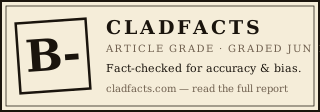
Letter grade, factuality, lean, and rationales — free with registration. No card required.
See grades free How grading works
Already have an account? Sign in. The full report below is free to read.
Embed this grade
Disagree with this grade or political lean?
Flagging is open to every reader with a free account. Sign in or create one to dispute this report.
Topics in this report
Summary
CBS News interview with Sen. Raphael Warnock covers the ~100-day US-Iran war under Trump, a preliminary US-Iran MOU to end hostilities and reopen the Strait of Hormuz, congressional approval needs, Warnock's war powers resolution (failed 47-48), gas prices, and geopolitical fallout. Second segment addresses Georgia runoffs, redistricting efforts, and criticism of the Supreme Court on voting rights and multi-racial democracy. Sourced from the senator with no opposing guests or data graphics referenced.
Editorial Assessment
Claims on war timeline, daily costs (aligned with early Pentagon/analyst estimates), Hormuz reopening, and Senate vote hold up to reporting. Interpretive assertions on war illegality, adversary benefits, and unresolved nuclear issues reflect partisan perspective without balancing context on negotiations or regime stability. Redistricting and SCOTUS segments present a consistent left-leaning frame on electoral maps and court decisions but omit recent SCOTUS voting rights precedents or state-level justifications. Viewer misses administration rationale for military action and full nuclear deal details.
Key Moments
War lasted a little over 100 days; nearly $1B/day spent
Matches Feb 28 start and early cost estimates from DOD/analysts
Strait of Hormuz reopened but was open before war; deal returns to pre-war status
Deal includes reopening after blockade; pre-war status disputed by blockade reports
Senate war powers resolution introduced; failed 47-48
Warnock resolution; exact vote confirmed in Senate records
Enriched uranium issue unaddressed; regime in place, possibly harder-line
Nuclear talks ongoing per deal; regime stability aligns with reports but details sparse
SCOTUS enabling gerrymandering, moving back from multi-racial democracy
Opinion on recent rulings; no specific cases or counter-evidence cited
Notable Concerns
- Heavy reliance on one Democratic source without counter-perspectives
- Limited context on enriched uranium status or cost breakdowns
Sources Consulted
- VIDEO: Warnock Votes to Force an End to Iran War
- Warnock Introduces War Powers Resolution to Stop President Trump’s War in Iran
- Sen. Raphael Warnock introduces measure to block U.S. military action in Iran during ceasefire
- Warnock Statement on President Trump’s Ceasefire in Iran
- S.J.Res.59 - 119th Congress (2025-2026): A joint resolution...
- Roll Call Vote 119th Congress - 2nd Session
- Warnock Statement on Supreme Court's Gutting of Voting Rights Act
- Warnock: Supreme Court dealt 'devastating blow' to democracy with Voting Rights Act ruling
- Sen. Raphael Warnock says Supreme Court's voting rights decision 'poured fuel on this redistricting arms race'
- Supreme Court decision weakening Voting Rights Act could impact future political maps in Georgia
- Georgia Redistricting and Congressional Districts
- Full interview: Sen. Raphael Warnock of Georgia