Blunt Rochester Questions Experts on AI in K-12 Education at Senate Hearing
Source: Forbes Breaking News · All Forbes Breaking News reports
Unlock the full scoreboard
Letter grade, factuality, lean, and rationales — free with registration. No card required.
See grades free How grading works
Already have an account? Sign in. The full report below is free to read.
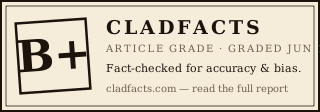
Embed this grade
Disagree with this grade or political lean?
Flagging is open to every reader with a free account. Sign in or create one to dispute this report.
Topics in this report
Summary
The segment shows Sen. Lisa Blunt Rochester (D-DE) at a Senate Health, Education, Labor and Pensions Committee hearing questioning witnesses on AI use in K-12 education. She references her own AI literacy test, highlights state-level work as laboratories for policy, and asks about exciting developments in Delaware, challenges like privacy and bias, and unique federal roles.
Witnesses include Delaware Education Secretary Cindy Marten (transcribed as Martin), who discusses state guidance implementation, teacher support, accessibility, and needs for federal evidence-based paths; Ms. Mode on the lack of long-term causal studies; and Mr. Jones of QuantHub on rapid curriculum refresh rates due to AI advancement. The clip ends with encouragement for public input, including from youth.
Editorial Assessment
The broadcast accurately captures a substantive exchange on AI education policy without introducing unsubstantiated claims. Viewer perception may be skewed by the absence of full hearing context, such as other witnesses' testimony or opposing views on federal vs. state roles. Claims about Delaware's pre-existing generative AI guidance and University of Delaware resources align with public state documents. Missing elements include details on the full panel composition and any data presented on AI adoption rates. Overall, it provides a balanced window into expert concerns but could benefit from sourcing the specific hearing date and outcomes.
Key Moments
University of Delaware offers an AI literacy test covering ethical issues and model limitations.
UD Library provides an AI Literacy Tutorial on LLMs, hallucinations, bias, and ethics.
Delaware has developed generative AI guidance for schools before the current secretary's tenure.
Delaware DOE released generative AI guidance in 2024 covering implementation, classroom use, and professional learning.
No high-quality causal studies exist on long-term AI effects on student learning and equity.
Statement from witness; aligns with calls for more research but emerging studies post-2024 may provide partial data.
AI curriculum refresh rates must account for exponential tech change, potentially lasting only 6 months.
Opinion from QuantHub witness; reflects rapid AI evolution but no specific 6-month benchmark verified in sources.