MS NOW segment critiques Trump on Iran war deal, low approval ratings
Source: MS NOW · All MS NOW reports
Unlock the full scoreboard
Letter grade, factuality, lean, and rationales — free with registration. No card required.
See grades free How grading works
Already have an account? Sign in. The full report below is free to read.
Embed this grade
Disagree with this grade or political lean?
Flagging is open to every reader with a free account. Sign in or create one to dispute this report.
Topics in this report
Summary
Nicolle Wallace and guests Cornell Belcher and John Halman discuss Trump’s handling of the ongoing Iran conflict and economy. Segments cover a recent war-end memorandum, Trump’s stock-market comments during remarks, and polling showing low economic approval (one-third) and overall ratings around 36%. Guests highlight voter dissatisfaction among independents, rural, and suburban groups, plus comparisons to prior presidents.
Editorial Assessment
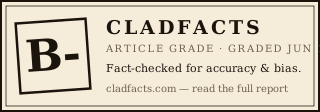
The broadcast accurately cites recent polling trends (Fox, YouGov, Reuters) showing Trump underwater on the economy and war amid the 2026 Iran conflict. The war timeline and deal signing match reporting from NPR, NYT, and others. However, the segment frames all developments negatively without noting bipartisan elements or deal mechanics, and opinion dominates over neutral sourcing. Viewers miss balanced context on war outcomes or Republican polling pockets. Strong left lean evident in loaded phrasing.
Key Moments
One-third of Americans approve of Trump’s economy handling; lower than Biden or first-term Trump
Aligns with AP-NORC, Economist/YouGov, and Fox polls from May-June 2026 showing ~30-33% economy approval
64% disapprove of war handling per Fox poll
Fox News May 2026 poll reported 60% opposition to military action, rising from prior month
Trump signed deal to end war without strategic gains
June 2026 memorandum ended active fighting but included sanctions relief and 60-day talks; critics and supporters differ on gains
Trump’s foreign policy driven by stock market reaction
Transcript paraphrase of Trump remarks; no primary transcript or quote confirms direct causation claim
Notable Concerns
- Heavy partisan framing without counter-sources