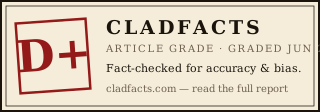
TalkTV panel skewers Starmer record amid Labour leadership shift to Burnham
Source: TalkTV · All TalkTV reports
Unlock the full scoreboard
Letter grade, factuality, lean, and rationales — free with registration. No card required.
See grades free How grading works
Already have an account? Sign in. The full report below is free to read.
Embed this grade
Disagree with this grade or political lean?
Flagging is open to every reader with a free account. Sign in or create one to dispute this report.
Topics in this report
Summary
The broadcast recaps Keir Starmer's resignation speech and the rapid shift toward Andy Burnham as the likely next Labour leader and prime minister without a contested vote. Guests including Isabelle Oakshott, Simon Danuk and others criticize Starmer's two-year record on immigration, defense spending, the Chagos deal, NHS waiting lists and the jailing of individuals like Lucy Connolly after the Southport riots.
Editorial Assessment
The segment functions as partisan commentary rather than neutral reporting, emphasizing negative interpretations of Labour actions while downplaying counter-data on migration reductions or economic indicators. Viewers miss balanced sourcing or official statistics on small boat crossings and asylum processing. Framing portrays Starmer's legal adherence as weakness and Burnham's potential as untested but preferable. The Churchill exhibit discussion correctly notes historical inaccuracies but generalizes to broader 'self-loathing' claims without nuance.
Key Moments
Starmer listed small boats and defense as achievements despite ongoing crossings and recent defense secretary resignation
Small boat arrivals were down ~13% year-on-year per Migration Observatory data; Chagos deal was paused by 2026 amid external pressure.
Lucy Connolly and others were jailed as 'political prisoners' for social media posts after Southport
Connolly received 31 months for inciting racial hatred via X post; court documents confirm guilty plea and sentencing rationale.
Starmer's economy claims (wages rising faster than inflation, stronger than peers) were fictitious
Transcript disputes without citing contemporaneous ONS or Treasury data; presented as fact by guests.
National Portrait Gallery sponsored a lie about Churchill deliberately starving Indians in 1943 Bengal famine
Gallery later removed the film after criticism; historical consensus attributes famine primarily to wartime factors and local issues, not deliberate Churchill policy.
Notable Concerns
- Heavy reliance on opinion over primary data for economic and immigration claims
- Guest selection skewed toward critics of Labour and progressive policies