PBS examines Washington's embrace of cabinet debate and balance
Source: PBS NewsHour · All PBS NewsHour reports
Unlock the full scoreboard
Letter grade, factuality, lean, and rationales — free with registration. No card required.
See grades free How grading works
Already have an account? Sign in. The full report below is free to read.
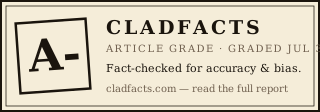
Embed this grade
Disagree with this grade or political lean?
Flagging is open to every reader with a free account. Sign in or create one to dispute this report.
Topics in this report
Summary
The PBS NewsHour clip features presidential historian Lindsay Chervinsky discussing George Washington's leadership evolution. It covers his early military mistake at Fort Necessity and how he later deliberately sought diverse counsel. Segments address a viewer question on unresolved conflict in his cabinet, particularly between Hamilton and Jefferson. Chervinsky explains Washington's use of councils of war for debate and his efforts to triangulate positions. The discussion draws on cabinet records and counters narratives of Hamilton dominance.
Editorial Assessment
The segment accurately portrays Washington's intentional inclusion of opposing perspectives as a leadership strength, backed by documented practices from the Revolution and presidency. Viewers may miss deeper detail on specific policy outcomes where Washington sided with one or the other, or the broader context of emerging party divisions. Framing is measured and educational rather than interpretive. Minor limitation is reliance on a single historian without counter-expert or primary document excerpts. Overall, it provides reliable context on deliberative governance without distortion.
Key Moments
Washington learned from Fort Necessity mistake by improving force positioning and listening to advice
Supported by historical analyses of his French and Indian War experiences at Mount Vernon and other sources
Washington used councils of war to pose questions and let officers debate to expose weaknesses
Matches documented Revolutionary War practice of soliciting input before decisions
Washington sided with Jefferson nearly 50% of the time against Hamilton, seeking middle ground
Broadly accurate per cabinet records and historians; exact percentage approximate but balance is well-established
Narrative of Washington being controlled by Hamilton was Jefferson propaganda
Reflects modern historical consensus rejecting simplistic dominance claims