Warner criticizes Trump Iran war, warns on Hormuz closure and gas prices
Source: ABC News · All ABC News reports
Unlock the full scoreboard
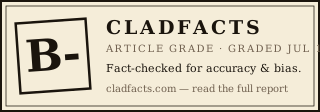
Letter grade, factuality, lean, and rationales — free with registration. No card required.
See grades free How grading works
Already have an account? Sign in. The full report below is free to read.
Embed this grade
Disagree with this grade or political lean?
Flagging is open to every reader with a free account. Sign in or create one to dispute this report.
Topics in this report
Summary
ABC News interviews Sen. Mark Warner (D-VA), ranking member of the Senate Intelligence Committee, on the ongoing five-month US-Iran conflict. Warner discusses US casualties, failed war objectives including regime change and uranium removal, high costs of intercepting Iranian drones, and the blocked Strait of Hormuz driving up Virginia gas prices to $4 per gallon with no short-term resolution. The segment covers Warner's preference for diplomacy like the JCPOA, skepticism of bombing Iran into submission, calls for Congress to fund any continued effort, and criticism of Trump administration cuts to CISA and election assistance bodies. It also addresses voter ID and Warner's opposition to Jay Clayton as DNI nominee.
Editorial Assessment
The broadcast accurately captures the senator's assessment amid a real 2026 conflict involving Hormuz shipping disruptions and drone threats, with external reporting confirming Iranian attacks on vessels and the cost imbalance of defenses. Viewer context missing includes independent verification of pre-war Virginia prices, feasibility of ground operations for enriched uranium, or administration counterarguments on war progress and election measures. Framing emphasizes Democratic critiques without balancing perspectives on Iranian actions or US strategy; partisan sourcing limits nuance on disputed elements like SAVE Act impacts. Overall, substantive on policy debate but thin on evidence for load-bearing specifics.
Key Moments
Before the war, average gas in Virginia was $2.81; now $4, diesel at $5, with no short-term path to settle Strait of Hormuz
War-related shipping disruptions confirmed in multiple reports since Feb 2026, but exact Virginia prices lack corroboration in available data
US uses $2.5M missiles to shoot down $50k Iranian drones; Ukraine counters for $5k and offered tech rejected by Trump WH
Drone cost disparity ($20-50k vs multimillion-dollar interceptors) and Ukrainian cheap interceptors widely reported; deployment of similar tech to US forces noted
Iran enriched uranium remains; would require minimum 15,000 troops on ground for a week to remove volatile canisters
Enrichment status and operational details presented without cited intelligence or military assessment
Virginia has voter ID but not strictly photo ID; SAVE Act amounts to disenfranchisement especially for name changes
Virginia allows multiple ID forms including affidavits; national SAVE Act debate centers on citizenship proof requirements
Notable Concerns
- Specific Virginia gas price figures presented without citation or comparison data
- Unsubstantiated claim of 15,000 troops needed for uranium removal
- No independent sourcing on Ukrainian drone tech offer rejection