Huffman links congressional views on Christian nationalism to cultural assumptions favoring Christianity
Source: Friendly Atheist · All Friendly Atheist reports
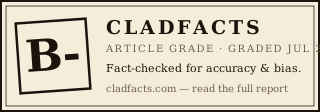
Unlock the full scoreboard
Letter grade, factuality, lean, and rationales — free with registration. No card required.
See grades free How grading works
Already have an account? Sign in. The full report below is free to read.
Embed this grade
Disagree with this grade or political lean?
Flagging is open to every reader with a free account. Sign in or create one to dispute this report.
Topics in this report
Summary
The clip features Rep. Jared Huffman explaining why many in Congress appear less attuned to Christian nationalism than outside observers. He describes a cultural reflex called Christian privilege that shields the movement from scrutiny to avoid accusations of anti-Christian bias. Huffman notes the movement receives a pass from media and lawmakers, requiring active digging into statements from figures monitored by Right Wing Watch. The segment highlights extreme clips of pastors as evidence of violence and treasonous rhetoric.
Editorial Assessment
The broadcast presents Huffman's analysis without counterbalancing data on varying definitions of Christian nationalism or the perspectives of its supporters in Congress. PRRI surveys document higher adherence among Republicans (55%) than Democrats (16%), supporting a partisan awareness gap but not necessarily a uniform 'pass.' Some Republican members have openly embraced the label, such as Marjorie Taylor Greene. The reliance on Right Wing Watch introduces sourcing from an advocacy group focused on right-wing monitoring. Viewers miss polling on public unfamiliarity with the term and distinctions between mainstream Christian conservatism and more explicit nationalist variants.
Key Moments
Congress members are less aware of Christian nationalism threats than outsiders due to cultural bias
Aligns with Huffman's Freethought Caucus role; PRRI polls confirm partisan differences in views but show rising term awareness overall
Christian privilege causes presumption that all things Christian are good and avoids scrutiny
Conceptual framing from secular circles; no specific polls or studies cited in clip to quantify effect on Congress
Christian nationalist movement gets a pass from media and Congress, requiring digging for extreme statements
Some members openly identify as Christian nationalists; polls indicate majority opposition to specific policies associated with it
Right Wing Watch clips reveal breathtaking extremism, violence, and treason from pastors
Right Wing Watch is a project of People For the American Way focused on right-wing monitoring; selection emphasizes outliers
Notable Concerns
- Heavy reliance on one-sided advocacy sourcing like Right Wing Watch
- Subjective 'privilege' framing presented without empirical measures or opposing views