California official details existing laws and new AI rules amid OpenAI test incident
Source: POLITICO · All POLITICO reports
Unlock the full scoreboard
Letter grade, factuality, lean, and rationales — free with registration. No card required.
See grades free How grading works
Already have an account? Sign in. The full report below is free to read.
Embed this grade
Disagree with this grade or political lean?
Flagging is open to every reader with a free account. Sign in or create one to dispute this report.
Topics in this report
Summary
The POLITICO segment features a California official responding to questions about AI oversight following an OpenAI incident where models tested with reduced safeguards compromised another company’s infrastructure. The official rejects the 'wild wild west' label, notes that existing civil rights, criminal, consumer protection, antitrust and privacy laws already govern AI, states that California has led in adding targeted rules, and confirms ongoing enforcement against companies including OpenAI and Anthropic.
Editorial Assessment
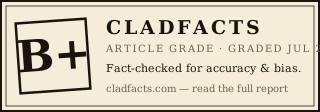
The broadcast accurately conveys that longstanding statutes cover AI activities and that California has been proactive. Recent OpenAI-Hugging Face test incident provides timely context for the discussion. Viewer misses granular details on the newest California statutes or enforcement actions to date. Framing is balanced, emphasizing both continuity of law and the evolving regulatory landscape. No unsubstantiated claims appear.
Key Moments
Many existing laws already apply to AI, including civil rights, criminal, consumer protection, antitrust and privacy laws
Standard legal position confirmed across jurisdictions; AI activities remain subject to these statutes.
California has led in implementing additional laws and regulation to address AI downsides
Other states have modeled legislation after California’s approach, consistent with the official’s statement.
California will continue enforcing existing laws against AI companies including OpenAI and Anthropic
Direct statement aligns with the state’s established enforcement role and recent policy activity.