Rep. Keith Self Introduces PRIVACY Act to Require Warrants for Flock Camera Data
Source: Rep. Keith Self · All Rep. Keith Self reports
Unlock the full scoreboard
Letter grade, factuality, lean, and rationales — free with registration. No card required.
See grades free How grading works
Already have an account? Sign in. The full report below is free to read.
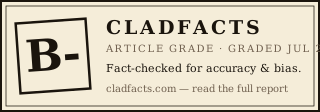
Embed this grade
Disagree with this grade or political lean?
Flagging is open to every reader with a free account. Sign in or create one to dispute this report.
Topics in this report
Summary
The interview with Rep. Keith Self (R-TX) on Point of View promotes his newly introduced PRIVACY Act, which requires federal law enforcement to obtain warrants before accessing state/local surveillance data like Flock Safety's ALPR cameras and limits data retention. Self describes Flock's expansion, links it to broader concerns including mandatory impaired-driving prevention tech in future vehicles (framed as a 'kill switch'), CBDC enabling social-credit-style control, and European/Canadian examples of government overreach. The segment also discusses his Preserving Our Constitution Act targeting Sharia law elements incompatible with the U.S. Constitution.
Sourcing relies on Self's statements, host Kerby Anderson's references to books by Jason Chaffetz and Ned Ryun, an article in The Texan, and Self's congressional website. No opposing experts or law enforcement perspectives on crime-solving benefits of ALPRs were included; callers or actions encouraged contacting Congress to co-sponsor the bill.
Editorial Assessment
The broadcast accurately reports the introduction and core provisions of the PRIVACY Act and the scale of Flock's deployment, which has drawn both praise for solving crimes and criticism over privacy. Viewers miss context that Flock data is primarily held by local agencies under varying state laws, many already imposing retention limits or warrant requirements, and that the bill targets only federal access. The 'kill switch' framing amplifies a real but narrower NHTSA-directed impaired-driving prevention mandate from the 2021 infrastructure law, which remains unimplemented due to technological challenges and focuses on alcohol impairment rather than political views or stress. Claims tying CBDC, European CSAM scanning proposals, and Canada's 2022 trucker protests into an imminent U.S. surveillance state lean heavily on worst-case slippery-slope scenarios with limited discussion of existing safeguards or public-safety rationales. Overall, it effectively raises legitimate privacy debates but through a partisan lens that could skew perceptions of current threats and legislative nuance.
Key Moments
Flock cameras are in 6,000 communities with 120,000 cameras and now use AI beyond simple license plate reading
Company and independent reports confirm over 5,000-6,000 communities/agencies and ~122,000 cameras mapped; AI enhancements for vehicle features are documented.
All cars will have a kill switch in 2027 that could prevent starting if the system detects impairment from stress, pregnancy, or exercise
2021 law directs NHTSA to require passive impaired-driving prevention tech (primarily alcohol detection); no final rule yet, no broad 'kill switch' for non-alcohol impairment or political use.
The PRIVACY Act requires warrants for federal access to local surveillance data like Flock and limits retention to 30 days
Bill text and Self's July 2026 press release confirm warrant requirement for federal querying of state/local data, 30-day retention limit unless extended by court or tied to prosecution.
Canada froze truckers' bank accounts during protests; Europe approved scanning of emails/texts/photos under CSAM pretext plus digital euro
Canada's 2022 emergency measures did freeze accounts; EU has advanced digital-euro rules with privacy provisions and debated CSAM client-side scanning, but full scanning mandates were narrowed or contested.
CBDC represents the final leg of a surveillance state enabling China-style social credit control over spending based on views or behavior
U.S. CBDC proposals remain exploratory with privacy debates; no enacted system exists, and parallels to China's deployed social credit are speculative rather than direct policy matches.
Notable Concerns
- Exaggeration of vehicle impairment technology as a politically controllable 'kill switch' beyond current regulatory proposals
- One-sided sourcing and framing emphasizing conservative concerns without law-enforcement or privacy-expert counterpoints
- Broad equation of U.S. proposals with China's social credit system without noting implementation differences
Sources Consulted
- Congressman Keith Self Introduces the PRIVACY Act
- Text - H.R.9716 - PRIVACY Act
- Flock cameras are now in 6000 US communities
- No, Your Car Isn't Getting a 'Kill Switch' in 2027
- Digital euro: MEPs want to ensure sovereignty, privacy
- They're Coming for You by Jason Chaffetz
- American Leviathan by Ned Ryun
- Texas Congressman Introduces Bill to Restrict Flock Cameras