Vance touts $230B fraud identified, $56B stopped; warns of 'President El-Sayed' undoing work
Source: Forbes Breaking News · All Forbes Breaking News reports
Unlock the full scoreboard
Letter grade, factuality, lean, and rationales — free with registration. No card required.
See grades free How grading works
Already have an account? Sign in. The full report below is free to read.
Embed this grade
Disagree with this grade or political lean?
Flagging is open to every reader with a free account. Sign in or create one to dispute this report.
Topics in this report
Summary
In a roundtable event focused on the Trump administration's Fraud Task Force, Vice President JD Vance described its whole-of-government approach to combating fraud in federal benefit programs. He highlighted dual victims—taxpayers and legitimate beneficiaries—citing specific Medicaid fraud cases involving newborn and maternal care, and detailed needs for congressional action on data sharing between states and the federal government, stiffer penalties, and additional resources. Vance warned that without codification, a future Democratic administration—specifically referencing 'President El-Sayed'—could reverse gains, while noting bipartisan cooperation with some Democratic governors and AGs. He was joined by Andrew Ferguson, co-chair of the task force.
The presentation relied on administration-generated figures and qualitative examples rather than independent audits. No opposing experts or Democratic critics appeared. Graphics or detailed source documents for the $230 billion and $56 billion were not referenced in the clip. The throughline emphasized urgency for legislative permanence amid claims of fraud in SNAP (including by ineligible non-citizens) and Medicaid.
Editorial Assessment
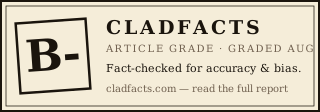
Vance's core claims about the task force's outputs are largely supported by contemporaneous White House and administration statements from mid-2026, though the $230 billion figure aggregates 'improper payments, systemic waste, and criminal fraud' rather than proven fraud alone. SNAP's high 10.62% payment error rate validates concerns over visibility and errors, but official data shows most overpayments stem from eligibility and administrative issues, not solely intentional fraud or non-citizen use. Medicaid improper payments are real but predominantly documentation-related (77%), not the 'despicable' service-free theft emphasized. Viewers miss context on ongoing lawsuits by over 20 states blocking broad data-sharing demands, viewing them as vehicles for immigration enforcement rather than pure anti-fraud measures. The casual invocation of Abdul El-Sayed—who just won Michigan's Democratic Senate primary—as a plausible 2028 presidential threat introduces speculative partisan alarm shortly after his victory over a moderate. Overall, the segment is a straightforward policy pitch from the administration but selective in framing and sourcing.
Key Moments
Fraud task force has identified $230 billion in fraud and stopped $56 billion in fraudulent payments using conservative estimates
Repeated in multiple administration releases and Vance speeches in July 2026; matches White House announcements though exact methodology for 'conservative' estimate is internal.
Medicaid program for new moms and newborns is defrauded by providers billing without delivering any service
Specific cases exist and have been prosecuted (e.g., Minnesota schemes), but national Medicaid improper payment rate is 6.12% with 77% due to documentation errors, not proven no-service fraud.
Federal government has no visibility into who receives SNAP benefits from state-administered funds, including illegal aliens and violent criminals
USDA has pushed for expanded data sharing since 2025; states resist citing privacy laws and potential use for immigration enforcement, with multiple lawsuits blocking broad demands.
God forbid you're going to have President El-Sayed in three years who could undo this work
Refers to Abdul El-Sayed's win in Michigan's August 4, 2026 Democratic Senate primary; no indication he is running for or positioned to win the presidency in 2028.
We need Congress to force data sharing, stiffer penalties, and modest funding to expand the task force, which returns 5-10x on investment
Direct policy ask aligning with the March 2026 Executive Order establishing the task force; return-on-investment claim is aspirational but consistent with administration statements.
Notable Concerns
- Partisan alarmism tying a fresh Senate primary winner to potential presidency in hyperbolic terms
- Conflation of 'fraud' with broader improper payments and waste without granular breakdown
- Omission of legal challenges and privacy concerns from Democratic-led states regarding federal data demands
Sources Consulted
- Establishing the Task Force to Eliminate Fraud
- USDA Announces FY 2025 State Payment Error Rates in SNAP
- Fiscal Year 2025 Improper Payments Fact Sheet
- JD Vance Stresses Out Over 'President El-Sayed' Winning
- Michigan Senate Primary Election 2026 Live Results
- A Look at the Medicaid Payment Error Rate Measurement (PERM) Program
- USDA wants states to share sensitive food stamp data
- The Trump Administration Is Ramping Up Medicaid Fraud Enforcement