McMahon Describes Positive University Responses to Higher Ed Reform Letter
Source: Forbes Breaking News · All Forbes Breaking News reports
Unlock the full scoreboard
Letter grade, factuality, lean, and rationales — free with registration. No card required.
See grades free How grading works
Already have an account? Sign in. The full report below is free to read.
Embed this grade
Disagree with this grade or political lean?
Flagging is open to every reader with a free account. Sign in or create one to dispute this report.
Topics in this report
Summary
In this Forbes Breaking News interview segment, Linda McMahon, U.S. Secretary of Education, discusses her August 3, 2026, “National Call to Action” letter sent to university presidents and governing boards. The letter urges institutions to publicly post commitments by the end of 2026 addressing seven areas: transparent merit-based admissions, free speech and open inquiry (including curbing disruptive protests), intellectual pluralism in faculty hiring, affordability and cost containment, academic rigor amid AI, research security from foreign influence, and prioritizing American interests. McMahon reports “incredible positive response” from universities highlighting existing efforts on free speech, merit-based admissions, and fostering debate rather than ideological monoculture. She specifically praises Florida’s system, citing Governor DeSantis’s response that public universities host required open debates at least quarterly featuring both sides of issues with professor involvement. The host asks whether non-compliant universities would face withheld federal funds; McMahon says the administration will “always monitor” but emphasizes the positive early feedback seen so far.
Editorial Assessment
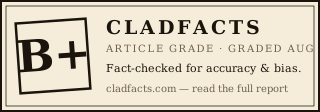
The segment accurately reflects the letter’s non-coercive tone and the substance of early state-level responses from Florida and the UNC System, which have publicly affirmed ongoing compliance with merit admissions, free-speech policies, and debate initiatives. Viewers receive a clear picture of the administration’s goals but miss important context: the letter follows a rejected 2025 “compact” that offered funding incentives and came amid multiple Trump administration investigations, funding freezes, and lawsuits against universities (including Harvard and UC) over antisemitism, DEI practices, and protest policies. While McMahon stresses bipartisanship and “collision of ideas,” the framing leans toward conservative critiques of higher ed “monoculture” and highlights Florida’s model without noting that many universities already have free-speech statements and that public trust polling (Gallup/Lumina) reflects concerns on multiple sides, including cost and job outcomes. Overall quality is solid for a short interview but selective in emphasis, potentially leading viewers to underestimate ongoing tensions between the administration and the higher-ed sector.
Key Moments
Letter urges universities to reform commitments to fair admissions, free speech, and tuition affordability
Matches the seven questions in the official August 3, 2026 Department of Education letter, which explicitly addresses merit-based admissions, free speech/open inquiry, and affordability/value of degrees.
Universities have given incredible positive responses, already doing work on free speech, merit-based admissions, and fostering debate
Early responses from Florida (August 18, 2026) and UNC System (August 20) cite longstanding policies on these issues and affirm compliance; several other states and institutions have begun similar reviews.
Florida schools hold required open debates at least once a quarter featuring both sides with professor involvement
Florida law (HB 931 and related statutes) requires public universities to maintain Offices of Public Policy Events and sponsor multiple debates annually featuring divergent views; McMahon’s “once a quarter” phrasing approximates the mandate but the system’s response to the letter confirms active implementation.
The administration will always monitor universities but the letter is not framed around withholding funds
The letter itself contains no funding threats or mandates; however, the broader Trump administration has used civil-rights investigations and funding conditions in 2025–2026, creating implicit leverage not mentioned here.
This should be totally across the aisle; collision of ideas advances education
McMahon presents the effort as nonpartisan, but the letter’s emphasis on “intellectual pluralism,” critiques of “monoculture,” and focus on curbing “unruly and violent protestors” align closely with long-standing conservative higher-ed reform priorities.
Notable Concerns
- Omission of prior-year funding threats and legal battles that provide context for why universities are responding
- Selective highlighting of Florida’s model without noting it is a state-mandated conservative reform
Sources Consulted
- U.S. Secretary of Education Linda McMahon Issues National Call to Action
- After Colleges Reject ‘Compact,’ Trump Officials Try a Letter
- McMahon Asks Colleges to Pledge Campus Reform by End of 2026
- How the UNC System Responded to McMahon’s “Call to Action”
- Governor Ron DeSantis Announces Florida Becomes First State to Respond
- Florida universities complying with law requiring political debates
- McMahon calls on college leaders to commit to policy reforms by end of year
- Trump administration asks colleges to commit to education overhaul