Washington Post rehires Karen Attiah after arbitrator rules firing over Charlie Kirk posts violated contract
Source: The Young Turks · All The Young Turks reports
Unlock the full scoreboard
Letter grade, factuality, lean, and rationales — free with registration. No card required.
See grades free How grading works
Already have an account? Sign in. The full report below is free to read.
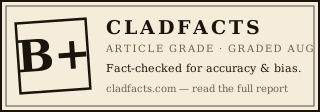
Embed this grade
Disagree with this grade or political lean?
Flagging is open to every reader with a free account. Sign in or create one to dispute this report.
Topics in this report
Summary
The Young Turks segment covers the reinstatement of Washington Post opinion columnist Karen Attiah, fired in September 2025 for Bluesky posts made on the day Charlie Kirk was assassinated at Utah Valley University. Hosts Anna and Cenk Uygur detail her 11-year tenure, her award for Khashoggi coverage, specific posts referencing political violence, the Minnesota Democratic legislators' shootings, and Kirk's past comments on Black women. They discuss her Substack defense, the Post's termination letter citing gross misconduct and staff safety risks, and the arbitrator's ruling that the paper violated her labor agreement by failing to prove misconduct, ordering immediate rehiring and back pay.
Sourcing relies on Attiah's own posts, Substack, the termination letter, and the arbitrator's decision. No named external experts appear; the hosts provide commentary throughout, with Cenk stressing freedom of speech and contract law while expressing personal disapproval of Attiah's rhetoric about 'white men' and the timing right after Kirk's death.
Editorial Assessment
The broadcast accurately reports the arbitrator's key findings and the basic timeline, supported by widespread coverage in The New York Times, Newsweek, The Guardian, and others. However, viewers miss fuller context on the Post's social media policy prohibiting disparagement based on race or gender, which the paper argued the posts violated, and the fact that Attiah's comments came hours after a high-profile political assassination that drew bipartisan condemnation. The framing leans toward portraying the firing as an overreach against opinion writing while downplaying how generalized statements about 'white men who espouse hatred and violence' could be viewed as inflammatory in the immediate aftermath. Hosts' tangents on unrelated topics like Israel introduce unnecessary bias. Overall, it provides a partial lens that may skew perception toward seeing Attiah solely as a victim of censorship rather than a case balancing editorial standards, union protections, and public backlash.
Key Moments
Karen Attiah was an award-winning opinion columnist at the Washington Post for 11 years and the last remaining Black full-time opinion columnist.
Corroborated by multiple reports including NYT, Newsweek, and Attiah's own statements; she won a special George Polk Award in 2019 with David Ignatius for Khashoggi coverage.
Attiah's Bluesky posts on Sept. 10, 2025, included references to Minnesota Democratic legislators being shot and statements about performative mourning for 'white men who espouse hatred and violence.'
Exact posts widely quoted in termination letter and reported by Business Insider, Newsweek, The Guardian; Minnesota shootings occurred June 2025, not 'just this year' in September context but accurate event.
The Washington Post fired her for gross misconduct, calling posts unacceptable and endangering to colleagues' physical safety.
Directly from the Sept. 11, 2025 termination letter published by Attiah and cited in arbitrator documents.
An arbitrator ruled the Post violated Attiah's labor agreement, failed to prove gross misconduct, and must rehire her with back pay.
Ruling by arbitrator Sarah Miller Espinosa reported consistently by NYT, Al Jazeera, WSJ, Reuters; decision dated around Aug. 2026 after grievance and hearing.
Freedom of speech requires defending even unpopular opinions, and the contract binds what the Post can do regardless of whether one likes what she said.
Hosts correctly note legal/contract outcome but omit nuances of private employer policies, union rules requiring progressive discipline for non-gross-misconduct cases, and ongoing debates over opinion writers' social media conduct.
Notable Concerns
- Hosts acknowledge Attiah's denial that posts were about Kirk but note it is '100% in the wrong' and urge her to 'own it,' yet the segment still frames her as primarily discussing broader political violence.
- Limited discussion of why the Post viewed the posts as endangering staff or harming integrity, relying heavily on Attiah's perspective.
- Mild factual looseness on the Minnesota shootings' recency and conflation of 'assassinations' with the actual events involving Melissa Hortman and others.
Sources Consulted
- Washington Post Ordered to Rehire Fired Columnist Karen Attiah
- What Karen Attiah said on Charlie Kirk as WaPo ordered to rehire her
- Washington Post ordered to reinstate Black opinion writer fired after Charlie Kirk posts
- WaPo Fired Columnist Citing 2 Social Posts After Charlie Kirk Killing
- Washington Post ordered to rehire columnist fired over Charlie Kirk posts
- Timeline of Charlie Kirk's assassination, the arrest of a suspect and the aftermath
- Karen Attiah and David Ignatius receive Special Polk Award for their writing on the murder of Jamal Khashoggi