Rep. Fedorchak marks Hyde Amendment's 50th anniversary, cites 2.7 million lives saved
Source: prolifeinformation · All prolifeinformation reports
Unlock the full scoreboard
Letter grade, factuality, lean, and rationales — free with registration. No card required.
See grades free How grading works
Already have an account? Sign in. The full report below is free to read.
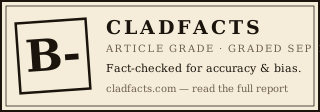
Embed this grade
Disagree with this grade or political lean?
Flagging is open to every reader with a free account. Sign in or create one to dispute this report.
Topics in this report
Summary
In a House floor speech during a Special Order hosted by Rep. Chris Smith (R-NJ), Rep. Julie Fedorchak (R-ND) commemorated the upcoming 50th anniversary of the Hyde Amendment, first enacted September 30, 1976. She described it as preventing taxpayer funds from paying for abortions, argued it has saved over 2.7 million lives (comparing the total to nearly three times North Dakota's population), and framed the anniversary as a call to honor life, support mothers, promote adoption, and strengthen families rather than a mere budgetary matter. Fedorchak rejected the idea that abortion equates to women's rights and emphasized that protecting unborn children and women are compatible goals rooted in the belief that every life has dignity.
The remarks were part of a broader pro-life caucus event with multiple Republican members speaking; no counterarguments or guests from the opposing side were included. Sourcing relied on an estimate from the Charlotte Lozier Institute (affiliated with pro-life research), with no independent data visualizations or named opposing experts presented.
Editorial Assessment
The speech accurately conveys the Hyde Amendment's core policy—no federal funds for most abortions, with exceptions for life, rape, and incest—and its constitutional upholding in Harris v. McRae (1980). The 2.7 million lives-saved figure aligns closely with updated Lozier Institute modeling through 2025, which uses academic studies showing funding restrictions reduce abortion rates. However, viewers miss critical context: the estimate is a statistical projection, not a direct count, and its assumptions (e.g., consistent 1.52 abortions averted per 1,000 women) are challenged by reproductive-rights groups who argue it overstates impact while understating burdens on low-income women and women of color, who rely on Medicaid at higher rates. The framing as solely about 'life' and 'dignity' with religious undertones and calls for maternal support omits longstanding critiques that Hyde has led to delayed or unsafe abortions and economic hardship. Overall, it is a persuasive advocacy speech rather than balanced journalism, likely reinforcing viewers' existing views on one side of the debate without exploring trade-offs or recent state-level variations post-Dobbs.
Key Moments
For almost 50 years, the Hyde Amendment has reflected the principle that taxpayer dollars should not be used to pay for abortions.
Confirmed by congressional records; first enacted in 1976 and renewed annually in HHS appropriations with narrow exceptions.
Since 1976, the Hyde Amendment is estimated to have saved more than 2.7 million lives.
Matches Charlotte Lozier Institute's latest projection (2.65 million through Sept 2025, rounded up in speeches); based on econometric models of abortion-rate reductions, not direct counts, and adjusted for states with independent funding or bans.
North Dakota has under a million people. That's nearly three times the number of people in North Dakota.
North Dakota's population is approximately 780,000; 2.7 million is roughly 3.5 times that figure, consistent with the rhetorical comparison.
Abortion is often presented as a measure of women's rights. I reject that. Protecting women and protecting unborn children are not opposing causes.
Opinion statement reflecting pro-life philosophy; no empirical data or sourcing provided in the speech, though it aligns with the speaker's stated convictions.
We must support mothers facing difficult circumstances... strengthening families, promoting adoption, improving maternal health care.
Advocacy goals presented without specifics on current federal or state programs; critics of Hyde note limited accompanying support services historically contributed to access barriers.
Notable Concerns
- Reliance on a single pro-life research institute for the central quantitative claim without acknowledging methodological debates
- Complete absence of opposing perspectives or data on disproportionate effects on low-income and minority women
- Religious and moral framing presented as universal American belief despite polling showing divided public opinion on taxpayer-funded abortion
Sources Consulted
- Hyde Saves Lives: Analyzing the Impact of the Hyde Amendment with 2025 Addendum
- The Hyde Amendment: An Overview
- Hyde Amendment Turns 49
- The Hyde Amendment and Coverage for Abortion Services Under Medicaid in the Post-Roe Era
- Hyde at 50: An Online Event with Regina Mahone, Amy Littlefield, Ana Rodriguez, and Nancy Cárdenas Peña
- Hyde Amendment | Wex | US Law
- Democrats and the History of the Hyde Amendment
- US House Floor Proceedings (Wednesday, September 16, 2026)