Pezeshkian tells Al Jazeera Iran will not initiate Hormuz blockade but may restrict access in response
Source: Al Jazeera English · All Al Jazeera English reports
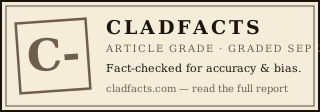
Why this grade: Graded C-: Pezeshkian's direct quotes were accurately presented, but the segment omits Iran's documented attacks on commercial vessels and enforcement of restricted routes, presenting a one-sided view of responsibility for the disruption.
Why this lean: The broadcast relies exclusively on the Iranian president's statements without countervailing US, Israeli, or independent maritime data, framing the US and Israel as the initiators of aggression and blockade while downplaying Iran's role in shipping incidents.
Embed this grade
Disagree with this grade or political lean?
Flagging is open to every reader with a free account. Sign in or create one to dispute this report.
Topics in this report
Summary
The short Al Jazeera English clip features Iranian President Masoud Pezeshkian stating that Iran will not initiate a blockade of the Strait of Hormuz but could restrict passage if the route is closed to Iran. He blames the United States for blocking the route and Israel for setting the region ablaze, asserting the waterway belongs to Iran and Oman and can be preserved by them. Pezeshkian insists the issue must be resolved through dialogue rather than force or bullying.
The segment is drawn from a longer interview aired September 26, 2026, amid the ongoing US-Israel war on Iran that began in late February 2026. It references a recent Iranian proposal linking reopening of the strait to lifting the US naval blockade, sanctions relief, and a broader ceasefire. No additional guests or graphics appear in the clip.
Editorial Assessment
The broadcast accurately captures Pezeshkian's quoted position but presents it without sufficient counter-evidence or independent verification, which could skew viewers toward accepting Iran's framing of the conflict as purely defensive. Missing context includes Iran's establishment of the Persian Gulf Strait Authority, demands for vessels to use Iran-approved routes, and multiple documented IRGC attacks on commercial ships in the strait since the June memorandum of understanding collapsed. The US reimposed its naval blockade in July 2026 specifically in response to those Iranian actions and non-compliance with the interim deal. Viewers are left without perspective on how the strait — through which roughly one-fifth of global oil trade once flowed — has seen severely restricted traffic, higher insurance costs, and reliance on alternative overland routes. The emphasis on dialogue contrasts with the pattern of tit-for-tat strikes that have persisted into September 2026.
Key Moments
Iran will not initiate blocking the Strait of Hormuz
Direct quote from Pezeshkian in the Al Jazeera interview; consistent with Iran's public proposals tying reopening to US concessions.
America is the one blocking the route and Israel is setting the region ablaze
US reimposed naval blockade in July 2026 after Iranian attacks on vessels and failure to honor June MoU; war began with US-Israeli strikes following earlier escalations.
The route belongs to us and to Oman; we can preserve it
Iran and Oman share territorial waters, but the strait is an international waterway; UNCLOS and historical practice affirm freedom of navigation beyond territorial seas.
They came and closed the route so that we could not go, so it is natural for us to close the route
Iran conducted drone and missile strikes on commercial ships (e.g., Ever Lovely, M/T Kiku) and enforced restricted corridors, actions that preceded or triggered aspects of the US response.
This matter can be resolved through dialogue not through force and bullying
Accurate paraphrase of Pezeshkian's repeated emphasis on negotiations in the interview and at the UNGA.
Notable Concerns
- One-sided sourcing limited to Iranian leadership without US or independent maritime security perspectives
- Omission of Iran's attacks on commercial shipping and route-enforcement measures that prompted the US blockade
- Framing of the Hormuz disruption as solely a US-initiated action despite mutual violations of the June MoU
Sources Consulted
- Pezeshkian says Iran ‘no longer trusts talks with Washington’
- Hormuz Crisis: Iran President Pezeshkian Says Diplomacy, Not Force, Can Reopen Strait
- In Strait of Hormuz, Renewed Strikes Threaten to Set Back Shipping Recovery
- Iran rejects UN-backed plan to free ships trapped in strait of Hormuz
- The crisis in the Strait of Hormuz is a heavy blow to the deteriorating maritime order
- Iran Shipping Update – September 25, 2026
- Challenges in the Strait of Hormuz as Ceasefire is Tested by Tit-for-Tat Strikes