Raskin urges high turnout to counter election fraud claims in House hearing
Source: Forbes Breaking News · All Forbes Breaking News reports
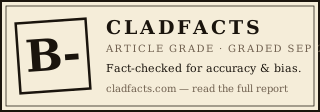
Why this grade: Graded B-: Core claims on 2020 court rulings, rarity of voter fraud per Brennan Center studies, constitutional limits on presidential election role, and SAVE Act status are largely verified by multiple sources, but hyperbolic framing of the bill as threatening 'tens of millions of American women' lacks precise evidence and omits counterarguments on noncitizen voting risks.
Why this lean: Solely Democratic witnesses and Raskin; repeated dismissal of Trump-era fraud concerns as 'hallucinatory' while praising defeat of SAVE Act and framing high turnout as defense against 'rigging'; no Republican perspectives or data on documented fraud cases.
Embed this grade
Disagree with this grade or political lean?
Flagging is open to every reader with a free account. Sign in or create one to dispute this report.
Topics in this report
Summary
The Forbes Breaking News clip covers a House hearing segment featuring Rep. Jamie Raskin questioning witnesses from the League of Women Voters, Brennan Center, and a Maryland election official. Discussion focused on post-SAVE Act threats, primarily misinformation undermining voter confidence, the absence of widespread voter fraud, constitutional design preventing presidential control of elections, and advice for administrators and voters to prepare for threats and turn out in high numbers. Raskin closed by calling for a 'landslide' turnout to make the election 'too big to rig and too real to steal,' emphasizing democracy requires daily effort.
Sourcing relied on witness testimony, references to 60 federal and state court decisions from 2020, Brennan Center studies, and the League's Vote411 tool. No anonymous sources; graphics were not referenced. Witnesses aligned with voting access advocacy; Raskin drove the narrative linking turnout to fraud prevention.
Editorial Assessment
The segment accurately reflects consensus among courts, academics, and most election officials that widespread voter-impersonation or noncitizen fraud capable of altering national outcomes is extremely rare, corroborated by multiple studies and the Heritage Foundation's own database showing low numbers relative to billions of votes cast. However, viewers miss context on documented instances of fraud in local races, administrative errors, and ongoing debates over mail-in ballot safeguards or noncitizen registration in some jurisdictions. Framing the SAVE Act solely as a threat to married women's documentation while it passed the House multiple times and targeted proof-of-citizenship requirements presents a one-sided view that could skew perception toward seeing all integrity measures as suppressive. Raskin's 'too big to rig' rhetoric, while motivational, echoes turnout strategies on both sides but here dismisses opposing concerns without engaging data on vulnerabilities. Overall quality is typical of partisan hearings: informative on one perspective but lacking balance that might better inform viewers ahead of 2026 midterms.
Key Moments
SAVE Act threatened votes of tens of millions of American women by requiring matching documentation for name changes
Bill stalled in Senate after multiple House passages; aimed at proof of citizenship, with critics citing burdens but supporters noting exemptions and state implementations; no independent estimate confirms 'tens of millions'.
60 different federal and state court decisions rejected every 2020 Trump election fraud claim
Multiple reviews, including by conservative legal experts in 'Lost, Not Stolen,' confirm ~60 cases with only one minor win insufficient to change outcomes.
Brennan Center has never found widespread voter fraud in 20 years of study; more likely hit by lightning
Brennan reports consistently find rates ~0.0001% or lower; lightning analogy widely used but contested on per-election vs. per-person basis by critics citing Heritage data.
Constitution gives states principal role in elections; presidents have no role to avoid executive abuse
Elections Clause (Art. I §4) assigns primary authority to states with Congress override; Article II limits presidential role in administration, reflecting Framers' concerns.
Best insurance against stolen election is a landslide turnout to make it too big to rig and too real to steal
Rhetorical call to action; no empirical evidence that higher turnout prevents sophisticated fraud or manipulation, though it can reduce close-race disputes.
Notable Concerns
- Partisan witness selection and language like 'hallucinatory' dismissal of fraud claims creates echo-chamber effect
- Overstates SAVE Act impact on women without quantifying affected voters or noting state-level alternatives
- Omits counter-evidence from Heritage database or specific prosecutions that, while rare, fuel public skepticism
Sources Consulted
- Trump’s judicial campaign to upend the 2020 election: A failure, but not a wipe-out
- The Myth of Voter Fraud
- Lost, Not Stolen
- The Constitution and the federal election process
- Heritage Fraud Database: An Assessment
- Actions - H.R.8281 - SAVE Act
- No, Election Fraud Is Not as Unlikely as a Lightning Strike