Scaramucci traces Trump rise to China trade, unfunded wars and bank bailouts
Source: Channel 4 News · All Channel 4 News reports
Unlock the full scoreboard
Letter grade, factuality, lean, and rationales — free with registration. No card required.
See grades free How grading works
Already have an account? Sign in. The full report below is free to read.
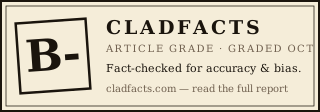
Embed this grade
Disagree with this grade or political lean?
Flagging is open to every reader with a free account. Sign in or create one to dispute this report.
Topics in this report
Summary
The Channel 4 News podcast features Anthony Scaramucci discussing his book 'All the Wrong Moves,' which attributes America's political anger and Trump's rise to three policy errors: admitting China to the WTO without safeguards, launching unfunded wars in Afghanistan and Iraq alongside tax cuts, and the 2008 bank bailouts that favored Wall Street over homeowners. Scaramucci advocates opening primaries, ending gerrymandering, and passing a constitutional amendment to limit money in politics, citing Citizens United as a turning point that skewed policy toward big business. He warns Britain against similar big-money influences in politics and discusses food safety issues like glyphosate in cereal and chlorinated chicken as examples of regulatory capture. The conversation ends with his prediction that Republicans will lose the presidency in 2028 due to anti-incumbent sentiment and exhaustion with Trumpism, plus reflections on his brief White House tenure and personal regrets.
Editorial Assessment
The interview presents a coherent, insider critique of bipartisan policy failures that fueled populism, backed by broad historical consensus on globalization's impact on manufacturing, the fiscal cost of post-9/11 wars, and the political fallout from TARP. Viewers get a clear throughline from economic dislocation to cultural anger and MAGA, but miss counterpoints: China's WTO entry coincided with massive global poverty reduction and lower consumer prices; debt growth accelerated under multiple administrations including recent ones reaching $40 trillion by late 2026; and incumbent reelection rates remain above 90% despite low approval. Scaramucci's prediction of a 2028 GOP loss aligns with current polling showing Trump disapproval in the 50s-60s and Democratic leads among independents, yet it underplays how economic performance or unforeseen events could shift that. Framing as 'three catastrophic decisions' simplifies complex trade-offs and omits regulatory successes or how post-bailout reforms like Dodd-Frank addressed some issues. Overall, thoughtful long-form analysis that leans reformist but could have included more data on wage stagnation reversal in recent years or primary system mechanics.
Key Moments
From George Washington to George W. Bush, the US spent $7 trillion in deficit spending; the next three presidents spent $33 trillion in 18 years
Bush added roughly $5 trillion (debt from ~$5.7T to ~$10.6T); total debt rose from ~$5.7T in 2001 to over $36T by 2025, with post-2001 additions exceeding $30T but not exactly $33T in 18 years; current debt exceeds $40T as of September 2026.
Congress has a 14% approval rating but a 95% incumbent reelection rate
Recent 2026 polls show congressional approval between 15-20%; House incumbent reelection rates have averaged over 90% in recent cycles per OpenSecrets and Ballotpedia, confirming the paradox but exact 14%/95% figures are approximate.
Citizens United (2010) allowed unlimited money in politics, skewing agenda toward big business, pharma, and tax cuts for the rich
The decision struck down limits on independent expenditures; subsequent super PAC spending has grown dramatically, with critics documenting increased influence of wealthy donors and corporations.
Allowing China into the WTO unchecked hollowed out US manufacturing and contributed to anger-based populism
Broad economic consensus links China's WTO entry and subsequent export surge to significant US manufacturing job losses (estimates of 2-3 million), though offset by lower consumer prices and global growth.
Republicans will lose the presidency in 2028 due to violent anti-incumbency and exhaustion with Trumpism
Current 2026 polling shows high Trump disapproval (~60%), Democratic leads among independents, and low congressional approval, supporting anti-incumbent mood, but a firm 2028 prediction is speculative and depends on economic conditions, candidates, and events.
Notable Concerns
- Exaggerated debt accumulation figures without precise sourcing
- Low Congress approval presented as 14% when recent data shows 15-20%
- Strong predictive claim on 2028 election based on current sentiment without caveats
Sources Consulted
- U.S. National Debt History, 1993–2026
- U.S. Debt by President: Dollar and Percentage
- Income in the United States: 2025
- Housing Inventory: Median Listing Price in the United States
- U.S. Congress public approval rating 2026
- Reelection Rates Over the Years
- Glyphosate; tolerances for residues
- All the Wrong Moves by Anthony Scaramucci